South Korea Starbucks Closes Stores Early After “Tank Day” Controversy
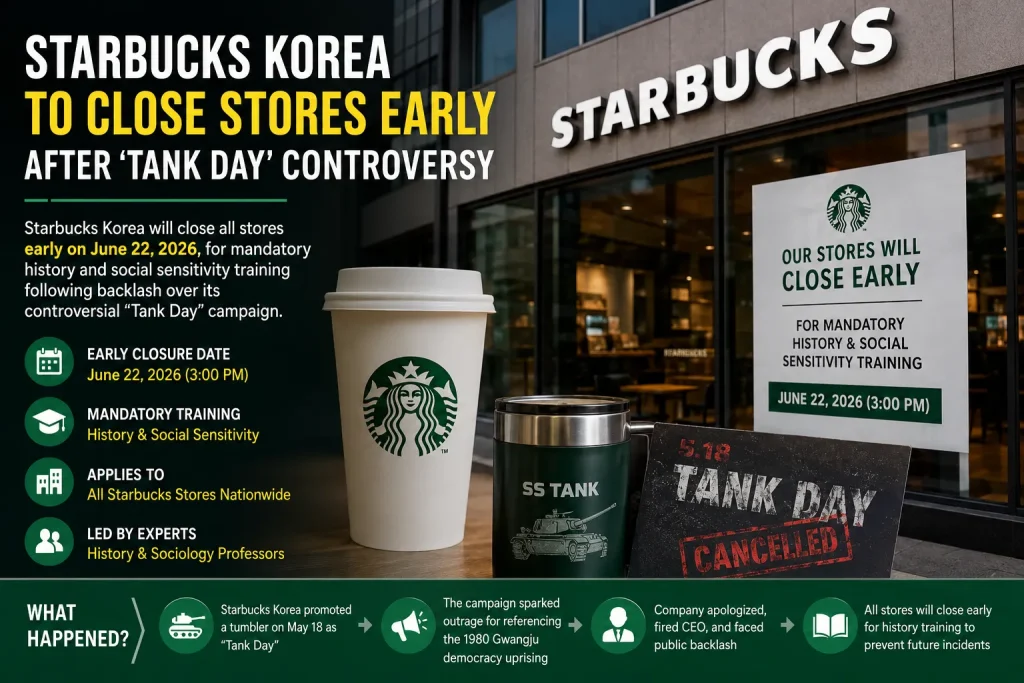
South Korea Starbucks has announced that all stores nationwide will close early on June 22, 2026, to allow employees to participate in mandatory history and social sensitivity training. The decision follows intense public backlash over a marketing campaign that many South Koreans viewed as insensitive to victims of the 1980 Gwangju pro-democracy uprising.
The controversy has become one of the biggest public relations crises in the history of Starbucks Korea, leading to executive dismissals, public apologies, and nationwide employee education initiatives.
Key Takeaways
- Starbucks Korea will close all stores early on June 22, 2026.
- Employees will undergo mandatory history and social sensitivity training.
- The move follows backlash over the company’s “Tank Day” tumbler promotion.
- Critics said the campaign appeared to mock victims of the 1980 Gwangju Uprising.
- Starbucks Korea’s CEO was dismissed, and the company issued a public apology.
- This is the first nationwide early closure since Starbucks launched in South Korea in 1999.
Why Is South Korea Starbucks Closing Stores Early?
Starbucks Korea announced that every store in the country will close at 3 p.m. on June 22 so employees can participate in company-wide training focused on Korean history and social responsibility. The training will be led by university professors specializing in history and sociology.
According to Starbucks Korea’s operator, the decision demonstrates how seriously the company views the controversy and its commitment to preventing similar incidents in the future.
What Was the Starbucks Korea “Tank Day” Controversy?
The controversy began in May 2026 when Starbucks Korea promoted a stainless-steel tumbler called the “SS Tank.”
The campaign referred to May 18 as “Tank Day.” However, May 18 is one of the most significant dates in modern South Korean history because it marks the anniversary of the 1980 Gwangju Uprising, a pro-democracy movement that was violently suppressed by the military government. Hundreds of people were killed or injured during the crackdown.
Many consumers and civic groups argued that using the term “Tank Day” on such a historically sensitive date was deeply inappropriate.
Why Did the Slogan Cause Additional Backlash?
The criticism intensified because the promotion included the phrase:
“Thwack it on the table!”
Many South Koreans interpreted the slogan as referencing a notorious statement used during the cover-up of the 1987 torture death of student activist Park Jong-chol. Authorities at the time falsely claimed he died after investigators struck a desk.
The combination of the “Tank Day” name and the slogan created widespread outrage across social media, political circles, and civic organizations.
Understanding the Historical Context
For many South Koreans, the Gwangju Uprising represents a defining moment in the nation’s struggle for democracy.
The Gwangju Uprising (1980)
| Event | Details |
|---|---|
| Date | May 18, 1980 |
| Location | Gwangju, South Korea |
| Cause | Pro-democracy protests against military rule |
| Government Response | Military crackdown involving troops and armored vehicles |
| Official Death Toll | Around 200 people |
| Historical Importance | Symbol of South Korea’s democratic movement |
Public anger over authoritarian rule eventually contributed to nationwide democratic reforms and direct presidential elections in 1987.
How Did Starbucks Korea Respond?
The company moved quickly after the backlash emerged.
Actions taken included:
- Canceling the promotion within hours.
- Issuing public apologies.
- Dismissing the Starbucks Korea CEO.
- Launching internal investigations.
- Creating mandatory history and sensitivity education programs.
- Implementing new review procedures for future marketing campaigns.
The company’s parent operator, Shinsegae Group, stated that stronger safeguards will be introduced to prevent similar mistakes.
What Is the Mandatory Training Program?
The training program will focus on:
- Modern Korean history.
- The significance of the Gwangju Uprising.
- Social responsibility in corporate communications.
- Cultural and historical sensitivity.
- Ethical marketing practices.
Headquarters employees and executives will attend sessions led by academic experts, while store employees will watch recorded versions of the training.
How Many Starbucks Stores Are Affected?
Starbucks Korea operates more than 2,000 stores nationwide, making it one of Starbucks’ largest international markets. South Korea is considered Starbucks’ third-largest market after the United States and China.
The June 22 closure affects virtually the entire network, making it one of the largest coordinated operational actions in the company’s history in the country.
Has Starbucks Korea Ever Closed All Stores Before?
No.
According to company statements, this will be the first time Starbucks Korea has closed all stores nationwide early for a company-wide training event since entering the South Korean market in 1999.
That fact highlights the seriousness with which the company views the controversy.
Impact on Starbucks Korea
The controversy has had consequences beyond public criticism.
Reports indicate:
- Sales declined after the backlash.
- Government agencies reconsidered Starbucks-related promotions.
- Public protests were held in several cities.
- Police investigations were launched following complaints from victims’ families.
The company hopes the training initiative will help rebuild public trust and demonstrate accountability. For more latest update, visit starbucksmenublog.com
What Happens on June 22?
On June 22, Starbucks Korea stores will:
- Operate normally during the morning.
- Close at approximately 3 p.m.
- Conduct mandatory employee training.
- Remain closed for the rest of the training period.
Customers planning to visit Starbucks Korea locations that day should expect reduced operating hours.
Also check latest blogs:
- Starbucks Disney Mugs & Tumblers Release June 19, 2026
- Gaithersburg Starbucks Becoming Dunkin’ at Former Coffee Shop
- Starbucks Coffee Craft
FAQs
Why is Starbucks Korea closing early on June 22, 2026?
Starbucks Korea is closing stores at 3 p.m. for mandatory history and social sensitivity training following backlash over its “Tank Day” marketing campaign.
What was Starbucks Korea’s Tank Day promotion?
It was a marketing campaign promoting an “SS Tank” tumbler and labeling May 18 as “Tank Day,” which many people viewed as insensitive because the date marks the anniversary of the Gwangju Uprising.
What is the Gwangju Uprising?
The Gwangju Uprising was a pro-democracy movement in May 1980 that was violently suppressed by South Korea’s military government. It remains a major symbol of Korean democracy.
How many Starbucks stores are affected?
More than 2,000 Starbucks Korea locations are expected to participate in the early closure and training program.
Did Starbucks Korea apologize?
Yes. Starbucks Korea and its parent company issued public apologies and canceled the campaign shortly after the backlash began.
Was anyone fired over the controversy?
Yes. Starbucks Korea’s chief executive was dismissed following the incident.
What will employees learn during the training?
Employees will receive education on Korean history, social awareness, ethical marketing, and cultural sensitivity.
Is this the first nationwide Starbucks Korea closure?
Yes. It is the first time Starbucks Korea has announced a nationwide early closure since entering the market in 1999.
Will all Starbucks Korea stores close?
Nearly all stores will close early, although some airport locations may have limited exceptions.
When will Starbucks Korea reopen?
Stores are expected to resume normal operations after the June 22 training event concludes.